Wednesday, 14 July 2010

REPORT - Transition Suffolk and the Pattern Language

Last Monday 8 Suffolk Transition initatives and 1 Norfolk (Diss) came together to discuss how to share resources and skills and to feedback ideas from the recent Transition Conference in Devon. Charlotte Du Cann from Sustainable Bungay reports:

I felt the meeting was significant. Many of the initiatives felt “on their own” and having already engaged in awareness-raising were looking for a new direction. Where do we go from here? There was a sense of urgency and a feeling we needed to relate to our communities and each other in a different way. I was struck as we drove through the golden barley fields towards Stowmarket and Linda and Josiah were exchanging childhood stories of fishing in farmer’s ponds (in Peasenhall and Thelnetham) that everyone in the room had the territory of Suffolk in common. We knew each others’ market towns and villages; the roads that connected them, the rivers and oak trees.These connections were to give this meeting a sense of reality and companionship that more civic“workshop” type gatherings do not have.

The meeting was held in a farm outhouse and took a very simple direct form. 22 of us sat in a circle for three hours with a short ten-minute break in the middle for very welcome cheese and beer kindly provided by our hosts, Glenn and Jeannie from Transition Debenham. The talk moved effortlessly from one speaker to the next and we covered a lot of ground.

After giving feedback about the workshops five of us attended (Social Enterpreneurship, Co-ops, Food Mapping, Communities, councils and carbon) and the influential Stoneleigh talk, Making Sense of the Financial Crisis in the Era of Peak Oil, we explored the new concept of Pattern Language which is set to replace the former organising structure of the 12 Transition Steps. The 63 Patterns form an interconnecting web of principles and activities that define a Transition initiative. We then discussed ways in which we could weave together our different experiences and projects, our Patterns, in order to provide a strong network and backing for each other.

In between our discussions, which ranged from biodiversity to “the Big Society” (we decided that Transition and Politics, the sixth level of Patterns, would be for another time) , we told stories about our initiatives. Some have become divided between haves and have-nots, some have been slowly gaining acceptance in the community, others that were successful last year with climate change and Copenhagen on the agenda but were now experiencing a lack of interest. Some of us felt overwhelmed when thinking of the future in large terms (“130,000 mouths to feed” as Steve Marsden said from Transition Ipswich), others felt by focusing on the small scale, on immediate and do-able working projects, such as garden shares, this provided a strong base for larger and more ambitious schemes.

Here were some of the projects/patterns that arose as examples during the discussion;

· Community Renewable Energy Companies 5.4 John talked about Transition Ipswich’s communty owned wind turbine which will help fund other local community projects.
· Food Initiatives and CSAs 3.10 and 5.9 Josiah talked about Bungay Community Bees and the Sustainable Bungay Pig Club.
· Arts and Creativity 2.8 and The Great Reskilling 3.11 Linda talked about Transition Halesworth’s Upscaling Bag project.

Dale from Transition Debenham explained how a sewing bag project could then expand into clothes making. Garden shares could expand into CSAs. By doing things together people could think as a community. For me that was the key shift. Transition provides a way to move out of a culture of individualism towards collective action. To open the door for people to work together in a new and meaningful way, to give heart and value to the ordinary things we can achieve.

How to proceed? Where should we go next? The key word of the Conference was urgency. It was clear that times of radical change were coming and that they would be felt in the financial sector first. People in Transition who had become personally resilient and understood the process of social change were in a position to provide coherent structures for communities - projects that offered solutions to the difficulties of an energy-poor future - as well as opportunities for self-government. Stoneleigh urged that Transition had a vital role in showing people there were other ways of doing things. This was the predominant mood of the meeting. In spite of individuals feeling their initiatives were not as up and running as they would like, as a collective, as a crew, we were coherent and committed. The buoyancy and sense of purpose was similar to that of the 2010 Conference in June. This was it. This was the time.

As the meeting came to a close we decided to meet again in September, to keep communications open and to share our resources. We agreed that Suffolk initiatives would begin to collate and “swap” patterns. I suggested the Transition East blog (www.transitioncircleeast.blogspot.com) could be a holding station/sorting house for everyone’s stories and pictures and provide material for a possible Transition Suffolk newsletter. A Transition Network on-line directory for the Patterns is meanwhile underway. (P.S. Running Successful Meetings is Pattern 2.4 and Forming Networks of Transition Initiatives 4.2)

The 2010 Conference Booklet that includes the Pattern Language is available as a pdf from www.transitionnetwork.org. A short precis of the 63 patterns will be posted shortly under Pattern Language (left hand sidebar)

Making patterns: first meeting of Transition Suffolk; barley field; Sustainable Bungay joining forces with the local Cycle Strategy; Transition Halesworth reskilling at the Library; The Bro-Dyfi Community Wind Turbine project that provided the inspiration for Transition Ipswich; wholefood co-op food pattern

Monday, 5 July 2010

Transition Suffolk - Meeting about 2010 Conference - Monday 12 July

There will be a meeting of Transition groups in Suffolk to exchange information and feedback from the 2010 Transition Network conference. David Price (Greener Fram) and Jeannie and Glenn (Transition Debenham) are hosting an evening for anyone who is interested in and around East Suffolk.

There will also be a discussion about local support between Transition groups. This will be an opportunity to see how our groups can work together to spread the load, as well as find out more about the bigger picture of Transition. All welcome.

The evening will be at Jeannie and Glenn's at 7:30.

Hill Farm
Framsden
STOWMARKET
Suffolk
IP14 6HA

For further information please contact David Price Email: davidstephenprice@me.com

Glenn (Transition Debenham) and David (Greener Fram) in conference during the Big Group Process, Day 2.

Norwich: Introduction to Permaculture Gardening Workshop - 10 July

Come and find out what Permaculture Gardening is all about. These informal workshops will cover the 12 Permaculture Design Principles, how to apply these in your own gardens to create edible, biodiverse and beautiful spaces, including using ponds, discovering Mulch (and why mulching matters!), companion planting, herb spirals, keyhole beds and composting. Also a session on Forest Gardening, layering and Perennial crops. and Permaculture gardeners question time!

The introductory workshop will be held at the Grow Your Own shed at Bluebell Allotments (South), from 10-4 on Saturday 10th July. Please bring something to share for lunch, hot drinks provided. £10 donation to cover costs. 10-12 participants. (Brenna Powys/Food & Farming)

To book a place please contact Mahesh Pant at sustainable@talktalk.net tel:01603 455868 www.grow-our-own.co.uk

Thursday, 17 June 2010

Ipswich/Beccles: Survival Tales performances

Hey everyone

This is short notice but I've been asked to secure a venue and date for a last appearance in this lady's first East Anglian tour - thankyou to residents of the Spinney for agreeing to host her! Please come to the performance next Thursday in Ipswich - it doesn't clash with anything! It's an intimate, interactive show. Circulate to your friends!

There are other performances on Wednesday night (Norwich) and Thursday afternoon (Ilketshall St Andrew) but for details of those contact
Jo Chitty www.jochitty@yahoo.com

See you there, Gemma x
___________________________________

Survival Tales
a performance and workshop by Eirlys Rhiannon

Thursday 24 June 2010 7.30pm*
The Spinney, 108 Westerfield Road, Ipswich
£5 (no-one turned away for lack of funds)
Places need to be booked in advance – sayersgemma@googlemail.com

* please note no admission to the show later than 8pm

What's it all about? See information below or visit http://www.survivaltales.org.uk/

========================================
To survive in this world, we each create stories.

Our stories affect people around us, and in turn we get affected by the stories we hear and see every day.

But there’s a new – and old – challenge looming: to realise that ‘how we live’ is also ‘how we kill’.

This challenge is phenomenally frightening.

To protect ourselves, we create safe stories: ‘the scientists are lying’, ‘the government will sort it out’, ‘this product will help’.

But the challenge remains.

We need to decide how we live – but how do we make decisions? Is this version of democracy the best we can do? Who’s in charge? Can we trust any of our solutions?
Can we learn anything from history? And does anyone have a super-hero cape in my size?

How do we tell the noose and the lifebelt apart?

=========================================

Survival Tales is a series of small, intimate performance events, designed to take place in unusual venues, including living rooms, community gardens and social centres. Each event has two parts:

- a performance featuring personal stories and songs

- a short workshop about how we make our survival stories

Touring selected parts of the UK during Summer 2010. Contact us for booking details:
http://www.survivaltales.org.uk/

Produced in association with Natasha Machin and Trapese Popular Education Collective, with assistance from Artist Project Earth
http://www.trapese.org/ http://www.apeuk.org/

Wednesday, 9 June 2010

Beccles: Community Apple Share Project 2010

Early Summer is now upon us and the glorious apple blossom has all but gone. That sea of pink will miraculously develop into delicious juicy fruit and it will all happen quicker than we think, so now’s the time to plan.

Last year, as part of the Sustainable Beccles group strategy, a group of folk began a scheme to marry unwanted apples with those who were keen to get their hands on some of these versatile fruit, and they plan to run the scheme again this year. If you live in the Beccles and Bungay area and have fruit you cannot pick, a group of people can help you by arrangement with the organizers. In addition we want to encourage planting local variety apple trees and also to run an apple flavoured lunch and talk on all aspects of growing fruit trees and getting to know apples in July.

If you are interested in the scheme from any aspect please get in touch. You may have more fruit than you can use, or maybe you have difficulty picking it; you may want to offer your services to help pick fruit for others or you may want some fruit for your pies and chutneys – whatever your interest, register it now, without commitment. Let’s celebrate this very English fruit and enjoy the abundance that grows locally – we’ll save more than the money.

Contact: netta.swallow@btinternet.com or ring 01502 470135 to register an interest in picking, giving or receiving fruit.

Thursday, 3 June 2010

Bungay Community Bees - Reappearance of the Bees

This May it's been a busy month in Transition. Plant swaps, carbon conversations, Strangers' circles, blogs, bulletins. And yesterday afternoon, bees.

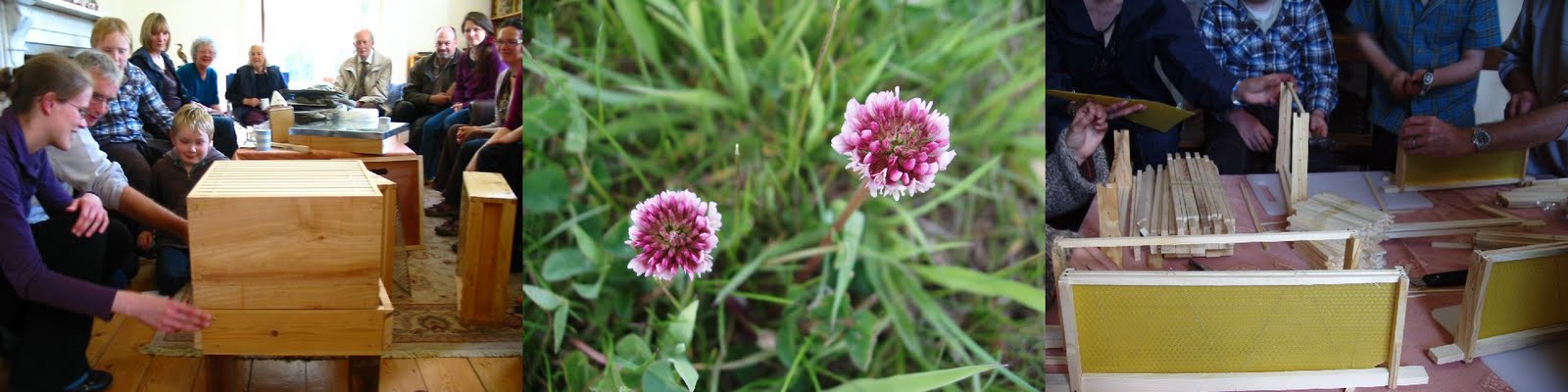
I've recently joined the Bungay Community Bees project (Britain's first bee CSA) and twenty five of us converged at Gemma's in Flixton to help build frames for the new beehives in time for the arrival of the first queen bees in June.

There really was a buzz as Elinor and Gemma reported on the progress so far. As well as getting our three hives (one of them donated), two more people are already being trained up as beekeepers and there are more and more offers of land where the bees can be kept...and of course, there's the bee blog. Meanwhile, Charlotte and Eloise are going to map out all the local wild and garden bee-loving plants and trees throughout the coming year.

Then we all got down to some serious woodwork. Luckily enough we had an experienced carpenter present - I haven't done any woodwork since school - a very long time ago - and I was not good at it!

People feel very strongly about bees. And particularly now with the loss of so many colonies here and abroad. Our neighbour Julia, who we bought the first hive from, lost hers in London. Waveney Valley beekeepers are reporting losses of about a third. And even the most experienced beekeepers say there seems to be no single, simple explanation. Keeping bees and providing organic, pesticide-free land with plants that bees love (like White Clover, pictured - pink when young and later turning white) has to be one way forward. See Sustainable Bungay's website for excellent bee links and information.

Yesterday I brought along Anise Hyssop and Mexican Hyssop for Gemma and Elinor. These are two of my favourite bee plants. I talk and fuss about them so much that Charlotte can't bear it any longer so don't tell her I'm writing about them on the blog! Anise Hyssop is also called Licorice Mint and the whole plant has an amazing smell of anis or licorice as its names suggest. The leaves make great tea. Mexican Hyssop has a more minty smell and is an ingredient in herbal medicine for the heart in Mexico. They are closely related and cross-pollinate so it's best to grow them far apart - especially as bees love them both madly and visit them with great gusto when they flower - which is over a long period in the summer. The seedheads are attractive, long-lasting and smell amazing. Enough! Enough of this encomium!

But the plant of the month must be Lemon Balm, which Andy talked about in his Deadly Resistances post. Also in the Mint family, its Latin name Melissa means honey bee. Both the smell and the tea of Lemon Balm really revive flagging spirits and cheer the heart. And bees really do love it. (Mark Watson)

Pics: Bungay Community Bees people get to grips with hives, frames and foundations, and young white clover in a bee friendly field; Anise Hyssop or Licorice Mint on either side of Mexican Evening Primrose, July

Wednesday, 12 May 2010

Seedling Swaps in May - Bungay, Norwich and Wivenhoe

Seedling Swaps are the happening event this Spring! This Saturday (May 15) there will be tables overflowing with small salad and vegetables plants all over Transition East Anglia. Transition Wivenhoe will be flourishing at the local Farmer's Market and Transition Norwich (see poster) on show at the Norwich Playhouse bar terrace.

Writes TN's allotment holder, Jane Chittenden: "Growing more of our own food is a great way to start designing a better future. Very environmentally friendly, doesn't require fossil fuel and kind to our pockets too! So we're having a plant swap, where we’ll have seedling plants (tomatoes and other veggies plus herbs and flowers too) and we invite people to bring along their own plants to swap. If you haven't got anything to swap for our plants, a donation would be much appreciated. Do come along with your plants - organic for preference, labelled and with advice on growing tips if possible!"

Sustainable Bungay’s lively Give and Grow seedling and plant swap was held in Bungay library courtyard on May 2. SB's Mark Watson reports: "The place was transformed inside and out with a constant lively buzz as people gathered, swapped plants and talked about everything from beekeeping to heritage bean varieties - in spite of the rain and the cold. We'd all been patiently (very patiently this year) growing our seeds for allotment and garden in homemade newspaper pots, toilet rolls and even ordinary pots. The tables were laden with vibrant healthy lettuces, currants of all colours, tree saplings, cosmos, mints, aloe vera, grasses, lemon balm, foxgloves, snowdrop bulbs, wild flower seeds, seed potatoes, cucumbers, the list goes on. And you had to be pretty quick as plants swapped hands even before they got on the tables. Especially the sturdy tomatoes which several people said they'd been having difficulty growing so far."

Time to get our hands in the earth!

Seedling Swaps on Saturday 15 May: Transition Norwich Playhouse Bar terrace, St George's St. 11am - 3pm. For more info contact info@transitionnorwich.org.

Transition Wivenhoe @ Farmers' Market, 9am-12noon @ Congregational Hall. 9am-3pm. Contact Julia (826015). Bring your excess veg & herb plants to swap/donate, or take some away for a small donation!

Taking home: rocket, lettuce, chives, pot marigold, lemon balm, lovely black grass and a rowan sapling