Tuesday, 21 September 2010

Norwich - Cycle Dynamo Workshop - 25 September

Build your own bike-powered generator - a kit made up of a Turbo Trainer, 250 watt generator, 12 volt battery and bits to join them together safely.

WHEN? Saturday 25th September 2010, 1-5 p.m.
WHERE? Friends Meeting House, Upper Goat Lane, Norwich NR2 1EW
COST? £120 incl. all parts & evening meal.

The non-profit workshop is led by Tom Foxe, electrician/TV engineer, bike lover, and builder of the Human Dynamo sound system. It's limited to 12 people, so early booking is advised.

What skills/knowledge do I need ?
If you can use a screwdriver you can do it ! The kit can be built by a child of, say 8+. We will NOT be going deeply into theory of electricity/ mechanics, we will focus on A. Safety B. Building the generator C. Applications

After the workshop there will be a Pedalpower Party including Live performances using a pedal-powered sound system and lighting and a short film, using a pedal-powered computer and data projector.

To book or for more information contact: Tom 01603 920801 or tom7railway@yahoo.co.uk.

Above: Tom Foxe on bike genny in action, Greenpeace Gig 2010. Left: Carol (Transition Downham Market/The John Preston Tribute Band) generating the power at last year's TN First Anniversary

Thursday, 2 September 2010

Suburban permaculture - Mike Guerra in Luton

A forthcoming permaculture afternoon in Luton. Details below, or on the Transition Luton website.


Suburban Permaculture: An Afternoon with Mike Guerra

Inspired by permaculture and forest gardening, Mike and his family grow up to 250 kg of food a year in their small suburban garden. This remarkably productive garden has inspired countless others in turn, and been documented in articles, on television, and in Mike's book 'The Edible Container Garden' - proving that you don't need a smallholding to get started in permaculture.

Saturday 25th September 2010, 1:45 for a 2pm start
High Town Methodist Hall, High Town Road, Luton
(Plenty of parking nearby, or two minutes walk from the station)

£6 - or £5 if you arrive on foot, by bike or public transport.

You can show up on the day, or email jeremy(at)makewealthhistory.org to reserve a seat.

Wednesday, 1 September 2010

Downham Market and Ipswich: Is Transition about to go Economic? - 14 September

This year's peak Transition event was arguably the economics lecture given at the Transition conference titled Making Sense of the Financial Crisis in the Era of Peak Oil. A recording of the talk will be broadcast and discussed on 14 September in Ipswich (see details at end of piece) as it was last month in a gathering organised by Downham Market and Villages in Transition. Members of Transition initiatives in Norfolk met in Stoke Ferry to reflect on what has come to be known as The Stoneleigh Effect. David Perry reflects on its implications:

On Sunday, 25th July some of us met at John & Carol’s straw bale studio to listen to a recorded lecture given by Nicole Foss of Automatic Earth, in which she talks of the impending "perfect storm" as the twin consequences of peak oil and the bursting of the credit bubble, created by the world’s "Ponzi" financial system, crashes and causes a period of brutal deflation. Deflation as part of a planned transition to a low energy economy is much to be desired, but it was the spectre of it’s unplanned and unexpected nature, with it’s numerous random consequences, of dramatic falls in house prices and a return to negative equity, that made it so scary. Perhaps not so surprisingly, some of us struggled to maintain a community focus as we began to reflect on the dire consequences for ourselves and our families. For all it’s wisdom and seeming inevitability it’s perhaps helpful to remind ourselves that this is a radical view that only time can validate.

During our meeting, reference was made to the 2010 Transition Network Conference Guide (12th - 14th June 2010). This includes details of the workshops and an introduction to Transition as a Pattern Language - a work in progress that looks forward to the further development of Transition beyond the 12 Steps. One of the conference workshops was entitled Communicating the Economic Crisis as the Third Driver of Transition and asks the question ..."should Transition now be talking about economics and the bursting of the debt bubble as a third driver? And ...to what extent ought an awareness of economics underpin Transition?"

At the end of the session, Gary Alexander distributed copies of a booklet entitled Sustainable Diss 2030: Food - Environment - Community. Addressed to the citizens of Diss, it’s introduction begins...Concerned about climate change, the credit crunch and other looming problems? Starting with The Good News it envisages what a sustainable Diss might look like in 2030, arguing that... If we don’t envisage and design a future we want, we might be forced into one that we don’t like - that’s the chapter on The Bad News. This refers to the human impact on the earth’s resources - climate change being one impact and peak oil being another, arguing... whatever we do next must put the environment at it’s heart. Not surprisingly, the message to the citizen’s of Diss is ...."the kind of economy we have experienced for the past few decades - wasteful, globalised, driven by economic growth instead of growth in well being needs to be replaced by a community-based economy that is more stable, resilient, self-reliant, less money-based, self-correcting, environmentally-friendly and uses much less oil."

Then on the following Tuesday, some of us met at Rachel’s to watch the film Money as Debt II: Promises Unleashed by Paul Dignon, a fascinating insight into the nature of money and how the banks have been licensed by governments to lend us money they don’t have, and then charge us interest on it! It deals with the massive expansion of credit which appears not to be backed by anything of value and yet unleashes massive purchasing power to consume goods and services that have to be provided from the finite resources of the planet. If anyone still doubts the potential of banking in it’s present form, and the prevailing financial system, to reduce the natural world with it’s vital life-support systems into a wasteland of commodities and synthetic novelty, this film is a must. Again, one is left with the clear conviction that we are saddled with a damaging and unsustainable economic system that urgently needs to be replaced with a more viable and sustainable model that uses money as a means of exchange rather than as a commodity.
A recently published book - Tim Jackson’s Prosperity Without Growth: Economics for a Finite Planet (ISBN 978-1-84407-894-3) argues for a new economic model that doesn’t rely on continuing growth to stabilise it....A different kind of economic structure is needed for an ecologically constrained world...Society is faced with a profound dilemma. To resist growth is to risk economic and social collapse. To pursue it relentlessly is to endanger the ecosystems on which we depend for long-term survival. We have to break free from the iron cage of consumerism and develop new community-based ecological enterprises in which the culture of consumerism is dismantled.

Having noted that the UK’s apparent 6 per cent reduction in carbon emissions between 1990 and 2004 is turned into a 11 per cent increase once emissions embedded in trade are taken into account, the author challenges the concept of decoupling - the idea of continuing growth without suffering the carbon consequences, by driving down the carbon intensity of production. A compelling case is made for the impossibility of achieving the IPCC’s target figure for CO2 reductions by 2050 through reductions in carbon intensity. Hence the title of the chapter - The Myth of Decoupling. Others have also acknowledged the impossibility of the UK achieving the rates of decarbonization required.

So what are the implications for Transition?

If the IPCC targets cannot be achieved through reductions in the carbon intensity of production and we accept the size of population as a given, it would seem that contraction in economic activity - Gross Domestic Product (GDP) offers the only prospect of reaching the IPCC targets and saving the planet’s ecosystems. This argues for an understanding of economics becoming an important aspect of Transition culture. Rather than it becoming a third driver, as hinted at in the 2010 Transition Network Conference Guide, perhaps economics will need to become the central concern that underpins all future Transition activities. David Perry


Transition Ipswich: At last month’s excellent Transition Suffolk gathering we touched on the Stoneleigh presentation – the one that had a big impact at the Transition conference. If you’re interested in seeing it, you and yours are welcome to join Transition Ipswich for a repeat performance at 7.30pm on Tuesday 14th September at University Campus Suffolk, Waterfront Building, Neptune Quay, Ipswich IP4 1QJ. We don’t actually have Stoneleigh in person, but we’ll be running the voice recording of her talk along with her slides. Afterwards we’ll discuss her prognosis and what it could mean for us, our families and the broader community, and how we can respond. We’ll finish by 10pm, but discussion will probably continue in the pub. The venue holds 60 so we have plenty of room. Please let me know if you’re coming so I can let the university security guys know how many people to expect. Steve Marsden steve_marsden@btopenworld.com

"Cocky and Little share their thoughts on the financial crisis"; Transition straw bale at Stoke Ferry. Photos by Gary Alexander (Transition Diss)

Cambridge: Wind turbine making course - 3-5 September


During this three day-course, everyone will get a chance to work on all aspects of building a wind turbine, including woodworking, metalworking and electrics. At the end of the course we will erect the turbine and see it in action (if it's windy!). The turbine we will be making is a 12V / 200W Hugh Piggott Axial Fluxturbine and will have a 1.2m blade diameter. The course will be run by Cambridge Greentech and V3Power and will be held at the Cambridge GreenTech workshop, Harvest Way, Cambridge. There are 12 places available. The cost is £150 before 25 June or £180 after that (this is much lower than normal thanks to the support of the Society for Environmental Improvement). Meals are included and we will do our best to put people up if you need somewhere to stay. More info and booking here: http://www.transitioncambridge.org/windturbine.

Saturday, 31 July 2010

Community Gardens – Transition King’s Lynn, Wivenhoe and Bungay

This month there are Transition Gardens in production and construction all over East Anglia. Produce is being swapped and shared, not just from garden shares and allotments, but from Transition plots in all sorts of extraordinary places. Here's our round up of some of the East's flourishing community gardens.

Transition King’s Lynn began their Edible Garden in the Walks (public park) in May 2009. They have been running regular workdays, planting and sowing days, picnics and tree pruning workshops ever since.

As part of Love Parks week last August Transition King’s Lynn staged an event that involved planting up lots more plants, including lavender donated by the Borough Council, and more vegetable and herb plants. Visitors to the bed were treated to a share in the harvest of salad leaves and French beans, and children were able to sow seeds of rocket, radish and oriental leaves in biodegradable origami pots to take away and plant at home.

Here's Viv from KL: "Some members of Transition King's Lynn set up a stall in the Walks to give away some of the produce from the bed. The feedback from this was very positive, though some people were suspicious as to why we were giving it away for free, and others simply couldn’t bring themselves to take it for free, so gave donations (gratefully received!). Other surplus produce has been donated to a local homeless charity to be used by the cooks in their day centres."

The produce from the bed is available for anyone to harvest and eat themselves. TKL is always open for more people to get involved -seeding, mulching, weeding, watering, dead-heading, harvesting etc. So do get in touch if you'd like to join in.

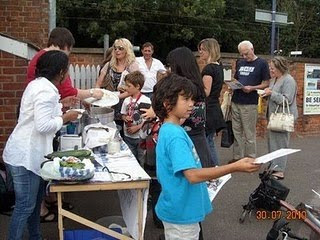
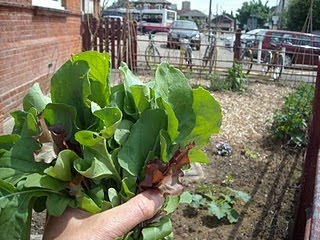
Transition Wivenhoe began their Station Garden this Spring and the Food Group has gained Network Rail's approval of the Station Master's House community food garden. Travellers, station staff, passers-by and garden volunteers have enjoyed crops of rocket and lettuce. Courgettes, peas, tomatoes, potatoes and winter squash are on the way. Volunteers have helped regularly at Broomgrove School veg patch, it has been lovely to suppport the children's enthusiasm for growing food.

This Friday they had a Station Garden cookout. Here's Peta of TW's very active Food Group: "The overwhelming verdict of the station house garden marrow curry, cooked up by Kaushali yesterday was "delicious!". This has been a much watched and commented on vegetable over the weeks as walkers, cyclists, commuters, garden helpers and station staff have witnessed the little courgette turn into a fine marrow. Even Wendy the station cat seemed to have an opinion, though perhaps a slightly dim one as she has had to shift her sun bathing spot as the monster plants have slowly taken over her space. Watch out as the winter squash are next to surprise and delight... along with the fantastic sunflowers of course. Over 40 bowls of veggie curry and handmade rolls were dished up to surprised passers by, a few commuters who made the time to stop and some Station Pub regulars, along with food group activists who set up the stall outside the entrance to platform 1.

In Bungay this summer we've been engaged in laying the foundation work of our Library Courtyard Garden (you can follow our Community Garden blog, brick by recycled brick!). Yesterday we shovelled 5 tons of top-soil into the beds ready for planting up our fruit trees (cherry and apple and pear) in our permanent bed and seasonal flowers, vegetables and herbs in our seasonal round bed. We’ve also got a wormery, rainbutts and compost bin, so our “Living Library”, as well as providing an outdoor meeting place and a quiet spot in turbulent times, will serve as a showcase for the ecological principles behind Transition. Designed by a working party formed after our Permaculture course (taught by Graham Burnett of Southend-in-Transition) in January it will be a living demonstration of everything from carbon reduction to water conservation, medicine plants to the restoration of the honeybee. We’re hoping to have a grand opening for everyone who has been so far involved in the project (about 100 people) in September.


Transitioners hard at work in King's Lynn Edible Garden; making banners under a Walks tree; planting the first potato at Wivenhoe's Station Garden; rocket to go; Sustainable Bungay workparty at the Library Courtyard.

Wednesday, 14 July 2010

REPORT - Transition Suffolk and the Pattern Language

Last Monday 8 Suffolk Transition initatives and 1 Norfolk (Diss) came together to discuss how to share resources and skills and to feedback ideas from the recent Transition Conference in Devon. Charlotte Du Cann from Sustainable Bungay reports:

I felt the meeting was significant. Many of the initiatives felt “on their own” and having already engaged in awareness-raising were looking for a new direction. Where do we go from here? There was a sense of urgency and a feeling we needed to relate to our communities and each other in a different way. I was struck as we drove through the golden barley fields towards Stowmarket and Linda and Josiah were exchanging childhood stories of fishing in farmer’s ponds (in Peasenhall and Thelnetham) that everyone in the room had the territory of Suffolk in common. We knew each others’ market towns and villages; the roads that connected them, the rivers and oak trees.These connections were to give this meeting a sense of reality and companionship that more civic“workshop” type gatherings do not have.

The meeting was held in a farm outhouse and took a very simple direct form. 22 of us sat in a circle for three hours with a short ten-minute break in the middle for very welcome cheese and beer kindly provided by our hosts, Glenn and Jeannie from Transition Debenham. The talk moved effortlessly from one speaker to the next and we covered a lot of ground.

After giving feedback about the workshops five of us attended (Social Enterpreneurship, Co-ops, Food Mapping, Communities, councils and carbon) and the influential Stoneleigh talk, Making Sense of the Financial Crisis in the Era of Peak Oil, we explored the new concept of Pattern Language which is set to replace the former organising structure of the 12 Transition Steps. The 63 Patterns form an interconnecting web of principles and activities that define a Transition initiative. We then discussed ways in which we could weave together our different experiences and projects, our Patterns, in order to provide a strong network and backing for each other.

In between our discussions, which ranged from biodiversity to “the Big Society” (we decided that Transition and Politics, the sixth level of Patterns, would be for another time) , we told stories about our initiatives. Some have become divided between haves and have-nots, some have been slowly gaining acceptance in the community, others that were successful last year with climate change and Copenhagen on the agenda but were now experiencing a lack of interest. Some of us felt overwhelmed when thinking of the future in large terms (“130,000 mouths to feed” as Steve Marsden said from Transition Ipswich), others felt by focusing on the small scale, on immediate and do-able working projects, such as garden shares, this provided a strong base for larger and more ambitious schemes.

Here were some of the projects/patterns that arose as examples during the discussion;

· Community Renewable Energy Companies 5.4 John talked about Transition Ipswich’s communty owned wind turbine which will help fund other local community projects.
· Food Initiatives and CSAs 3.10 and 5.9 Josiah talked about Bungay Community Bees and the Sustainable Bungay Pig Club.
· Arts and Creativity 2.8 and The Great Reskilling 3.11 Linda talked about Transition Halesworth’s Upscaling Bag project.

Dale from Transition Debenham explained how a sewing bag project could then expand into clothes making. Garden shares could expand into CSAs. By doing things together people could think as a community. For me that was the key shift. Transition provides a way to move out of a culture of individualism towards collective action. To open the door for people to work together in a new and meaningful way, to give heart and value to the ordinary things we can achieve.

How to proceed? Where should we go next? The key word of the Conference was urgency. It was clear that times of radical change were coming and that they would be felt in the financial sector first. People in Transition who had become personally resilient and understood the process of social change were in a position to provide coherent structures for communities - projects that offered solutions to the difficulties of an energy-poor future - as well as opportunities for self-government. Stoneleigh urged that Transition had a vital role in showing people there were other ways of doing things. This was the predominant mood of the meeting. In spite of individuals feeling their initiatives were not as up and running as they would like, as a collective, as a crew, we were coherent and committed. The buoyancy and sense of purpose was similar to that of the 2010 Conference in June. This was it. This was the time.

As the meeting came to a close we decided to meet again in September, to keep communications open and to share our resources. We agreed that Suffolk initiatives would begin to collate and “swap” patterns. I suggested the Transition East blog (www.transitioncircleeast.blogspot.com) could be a holding station/sorting house for everyone’s stories and pictures and provide material for a possible Transition Suffolk newsletter. A Transition Network on-line directory for the Patterns is meanwhile underway. (P.S. Running Successful Meetings is Pattern 2.4 and Forming Networks of Transition Initiatives 4.2)

The 2010 Conference Booklet that includes the Pattern Language is available as a pdf from www.transitionnetwork.org. A short precis of the 63 patterns will be posted shortly under Pattern Language (left hand sidebar)

Making patterns: first meeting of Transition Suffolk; barley field; Sustainable Bungay joining forces with the local Cycle Strategy; Transition Halesworth reskilling at the Library; The Bro-Dyfi Community Wind Turbine project that provided the inspiration for Transition Ipswich; wholefood co-op food pattern

Monday, 5 July 2010

Transition Suffolk - Meeting about 2010 Conference - Monday 12 July

There will be a meeting of Transition groups in Suffolk to exchange information and feedback from the 2010 Transition Network conference. David Price (Greener Fram) and Jeannie and Glenn (Transition Debenham) are hosting an evening for anyone who is interested in and around East Suffolk.

There will also be a discussion about local support between Transition groups. This will be an opportunity to see how our groups can work together to spread the load, as well as find out more about the bigger picture of Transition. All welcome.

The evening will be at Jeannie and Glenn's at 7:30.

Hill Farm
Framsden
STOWMARKET
Suffolk
IP14 6HA

For further information please contact David Price Email: davidstephenprice@me.com

Glenn (Transition Debenham) and David (Greener Fram) in conference during the Big Group Process, Day 2.