Monday, 5 July 2010
Norwich: Introduction to Permaculture Gardening Workshop - 10 July
Thursday, 17 June 2010
Ipswich/Beccles: Survival Tales performances
Hey everyoneThis is short notice but I've been asked to secure a venue and date for a last appearance in this lady's first East Anglian tour - thankyou to residents of the Spinney for agreeing to host her! Please come to the performance next Thursday in Ipswich - it doesn't clash with anything! It's an intimate, interactive show. Circulate to your friends!
There are other performances on Wednesday night (Norwich) and Thursday afternoon (Ilketshall St Andrew) but for details of those contact Jo Chitty www.
See you there, Gemma x
___________________________________
a performance and workshop by Eirlys Rhiannon
Thursday 24 June 2010 7.30pm*
The Spinney, 108 Westerfield Road, Ipswich
£5 (no-one turned away for lack of funds)
Places need to be booked in advance – sayersgemma@googlemail.com
* please note no admission to the show later than 8pm
==============================
Our stories affect people around us, and in turn we get affected by the stories we hear and see every day.
But there’s a new – and old – challenge looming: to realise that ‘how we live’ is also ‘how we kill’.
This challenge is phenomenally frightening.
To protect ourselves, we create safe stories: ‘the scientists are lying’, ‘the government will sort it out’, ‘this product will help’.
But the challenge remains.
We need to decide how we live – but how do we make decisions? Is this version of democracy the best we can do? Who’s in charge? Can we trust any of our solutions?
Can we learn anything from history? And does anyone have a super-hero cape in my size?
How do we tell the noose and the lifebelt apart?
==============================
Survival Tales is a series of small, intimate performance events, designed to take place in unusual venues, including living rooms, community gardens and social centres. Each event has two parts:
- a performance featuring personal stories and songs
- a short workshop about how we make our survival stories
Touring selected parts of the UK during Summer 2010. Contact us for booking details:http://www.survivaltales.org.uk/
Produced in association with Natasha Machin and Trapese Popular Education Collective, with assistance from Artist Project Earth http://www.trapese.org/ http://www.apeuk.org/
Wednesday, 9 June 2010
Beccles: Community Apple Share Project 2010
Last year, as part of the Sustainable Beccles group strategy, a group of folk began a scheme to marry unwanted apples with those who were keen to get their hands on some of these versatile fruit, and they plan to run the scheme again this year. If you live in the Beccles and Bungay area and have fruit you cannot pick, a group of people can help you by arrangement with the organizers. In addition we want to encourage planting local variety apple trees and also to run an apple flavoured lunch and talk on all aspects of growing fruit trees and getting to know apples in July.
If you are interested in the scheme from any aspect please get in touch. You may have more fruit than you can use, or maybe you have difficulty picking it; you may want to offer your services to help pick fruit for others or you may want some fruit for your pies and chutneys – whatever your interest, register it now, without commitment. Let’s celebrate this very English fruit and enjoy the abundance that grows locally – we’ll save more than the money.
Thursday, 3 June 2010
Bungay Community Bees - Reappearance of the Bees
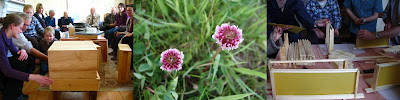
I've recently joined the Bungay Community Bees project (Britain's first bee CSA) and twenty five of us converged at Gemma's in Flixton to help build frames for the new beehives in time for the arrival of the first queen bees in June.
There really was a buzz as Elinor and Gemma reported on the progress so far. As well as getting our three hives (one of them donated), two more people are already being trained up as beekeepers and there are more and more offers of land where the bees can be kept...and of course, there's the bee blog. Meanwhile, Charlotte and Eloise are going to map out all the local wild and garden bee-loving plants and trees throughout the coming year.
Then we all got down to some serious woodwork. Luckily enough we had an experienced carpenter present - I haven't done any woodwork since school - a very long time ago - and I was not good at it!
People feel very strongly about bees. And particularly now with the loss of so many colonies here and abroad. Our neighbour Julia, who we bought the first hive from, lost hers in London. Waveney Valley beekeepers are reporting losses of about a third. And even the most experienced beekeepers say there seems to be no single, simple explanation. Keeping bees and providing organic, pesticide-free land with plants that bees love (like White Clover, pictured - pink when young and later turning white) has to be one way forward. See Sustainable Bungay's website for excellent bee links and information.
Yesterday I brought along Anise Hyssop and Mexican Hyssop for Gemma and Elinor. These are two of my favourite bee plants. I talk and fuss about them so much that Charlotte can't bear it any longer so don't tell her I'm writing about them on the blog! Anise Hyssop is also called Licorice Mint and the whole plant has an amazing smell of anis or licorice as its names suggest. The leaves make great tea. Mexican Hyssop has a more minty smell and is an ingredient in herbal medicine for the heart in Mexico. They are closely related and cross-pollinate so it's best to grow them far apart - especially as bees love them both madly and visit them with great gusto when they flower - which is over a long period in the summer. The seedheads are attractive, long-lasting and smell amazing. Enough! Enough of this encomium!
But the plant of the month must be Lemon Balm, which Andy talked about in his Deadly Resistances post. Also in the Mint family, its Latin name Melissa means honey bee. Both the smell and the tea of Lemon Balm really revive flagging spirits and cheer the heart. And bees really do love it. (Mark Watson)
Pics: Bungay Community Bees people get to grips with hives, frames and foundations, and young white clover in a bee friendly field; Anise Hyssop or Licorice Mint on either side of Mexican Evening Primrose, July
Wednesday, 12 May 2010
Seedling Swaps in May - Bungay, Norwich and Wivenhoe
Seedling Swaps are the happening event this Spring! This Saturday (May 15) there will be tables overflowing with small salad and vegetables plants all over Transition East Anglia. Transition Wivenhoe will be flourishing at the local Farmer's Market and Transition Norwich (see poster) on show at the Norwich Playhouse bar terrace.Writes TN's allotment holder, Jane Chittenden: "Growing more of our own food is a great way to start designing a better future. Very environmentally friendly, doesn't require fossil fuel and kind to our pockets too! So we're having a plant swap, where we’ll have seedling plants (tomatoes and other veggies plus herbs and flowers too) and we invite people to bring along their own plants to swap. If you haven't got anything to swap for our plants, a donation would be much appreciated. Do come along with your plants - organic for preference, labelled and with advice on growing tips if possible!"
Sustainable Bungay’s lively Give and Grow seedling and plant swap was held in Bungay library courtyard on May 2. SB's Mark Watson reports: "The place was transformed inside and out with a constant lively buzz as people gathered, swapped plants and talked about everything from beekeeping to heritage bean varieties - in spite of the rain and the cold. We'd all been patiently (very patiently this year) growing our seeds for allotment and garden in homemade newspaper pots, toilet rolls and even ordinary pots. The tables were laden with vibrant healthy lettuces, currants of all colours, tree saplings, cosmos, mints, aloe vera, grasses, lemon balm, foxgloves, snowdrop bulbs, wild flower seeds, seed potatoes, cucumbers, the list goes on. And you had to be pretty quick as plants swapped hands even before they got on the tables. Especially the sturdy tomatoes which several people said they'd been having difficulty
Time to get our hands in the earth!
Seedling Swaps on Saturday 15 May: Transition Norwich Playhouse Bar terrace, St George's St. 11am - 3pm. For more info contact info@transitionnorwich.org.
Transition Wivenhoe @ Farmers' Market, 9am-12noon @ Congregational Hall. 9am-3pm. Contact Julia (826015). Bring your excess veg & herb plants to swap/donate, or take some away for a small donation!
Taking home: rocket, lettuce, chives, pot marigold, lemon balm, lovely black grass and a rowan sapling
Tuesday, 11 May 2010
Kings' Lynn - Talk on Waste Management - Friday 14 May
Dr. Paul Connett is a graduate of Cambridge University and holds a Ph.D. in chemistry from Dartmouth College. Since 1983 he taught chemistry at St. Lawrence University in Canton, NY where he specialised in Environmental Chemistry and Toxicology. He retired in May 2006. Over the past 25 years his research on waste management has taken him to 49 states in the US, and 52 other countries, where he has given over 2000 pro bono public presentations. Ralph Nader said of Paul Connett, “He is the only person I know who can make waste interesting.”
The talk is free and open to everyone, it is hoped that some of those councillors who are proposing and supporting the incinerator will make themselves available to attend the talk. It will be at the NORA offices 6:30pm for a 7pm start, till 9pm Friday 14th May. The NORA offices are on the South Gate roundabout. There is a small car park on site. Don’t miss this opportunity to hear an independent expert’s view of the incinerator.
Wednesday, 21 April 2010
Bungay Community Bees - New Spring Project
Recently bees have been disappearing in their millions, affecting not only the production of native honey in every country, but most importantly, the bees' great task of pollinating the trees, fruit, vegetables and herbs that make up two-thirds of what we eat every day. In Bungay a new group has formed within Transition initiative, Sustainable Bungay, to help the threatened honey bee.
Bungay Community Bees is a Beekeeping Project which aims to manage hives in as sustainable a manner as possible. It will run as a CSA (Community Supported Agriculture) scheme where members own ‘shares’ in the bees, hives and harvest, taking part in the beekeeping year. This allows members to support honey bees without being ‘hands on’ - though the group plan is to fund training and hives for up to two new beekeepers each year.
“We are not a commercial venture and honey production is viewed as a bonus rather than a prime motive for bee keeping. We aim to use two or three systems over the next few years until we find one that suits us and the bees best.”
In the first year Bungay Community Bees hopes to recruit at least 20 supporters to invest in two hives (National type) and colonies, insurance for two beekeepers, basic equipment and training for two new beekeepers with the Waveney Beekeepers Group. Benefits will include visits to the hives to learn more about beekeeping, an opportunity to have a hive in your garden and most exciting of all, attending a honey harvest. The share of honey and wax will increase as the hives grow in strength and number.
Bungay Community Bees is being organised by Elinor McDowall and Gemma Parker. Both Transition beekeepers learned their art with the Waveney Valley Beekeepers and already have two hives and fifteen members signed up for the project.
“We’re hoping to acquire our first bees via the Waveney Beekeepers Group” said Elinor. “These are likely to be a mongrel mix of Italian origin and native British bees. However, in future years we would like to try some more native bees which are smaller and darker and because they are well- adapted to this climate, may be more resilient in times of change.”
In Waveney, there has been a huge increase in beekeeping interest. Last November the documentary, Vanishing of the Bees was shown to a packed audience at Geldeston Village Hall and a great cheer went up in the audience as Suffolk Beekeepers were seen marching to Parliament with their petition to help save the endangered bee.
In response gardeners everywhere are starting to growing flowers for the bees in their gardens and windowsills and local and sustainably-harvested honey has become highly-sought after. But perhaps the most effective way everyone can help starts at the table.
Colonies are made vulnerable to disease (especially the varroa mite), by the widespread use of pesticides and lack of bio-diversity in single-crop farming, as well as the the stressful nature of commercial beekeeping.
By eating fruit and vegetables grown without chemicals on organic farms or in local allotments and gardens which support a strong diversity of wild and domestic plants we will be giving pollen and nectar to one of our greatest allies on earth.
If you want to start a bee-friendly garden this summer, why not come along to Sustainable Bungay’s Give and Grow Seedling Swap on Sunday May 2 at the Bungay Library Courtyard and meet the Bungay Community Beekeepers?
If you would like to join Bungay Community Bees contact info @sustainablebungay.com. Membership is £20 per annum. The Give and Grow Seedling Swap is on May 2, Bungay Library Courtyard, 11am-2pm. For more information about the project and how CSAs work contact www.sustainablebungay.com.